I still remember the afternoon when I sat at my kitchen table, letter in hand, and realized that this month’s rent, plus car insurance, plus groceries… wouldn’t leave much room for anything unexpected. There was a flat tire waiting, and a kid’s school trip next week. Suddenly, the $200 “extra” I thought I had tucked aside felt like a mirage.
If you’ve ever felt that tightening in your chest between paychecks, bills, and daily life you know what I’m talking about. Maybe you’re a single parent juggling shifts, or a young couple trying to build stability. Maybe you’ve had to choose between groceries or medications, or braced for that heart-pounding fear whenever someone coughs or the car makes a new noise.
In 2025–2026, this pressure is real for so many. Costs are rising. Rents surge. Inflation lingers. Hourly work schedules shift. And savings? For most, they’re a distant dream. Forbes+1
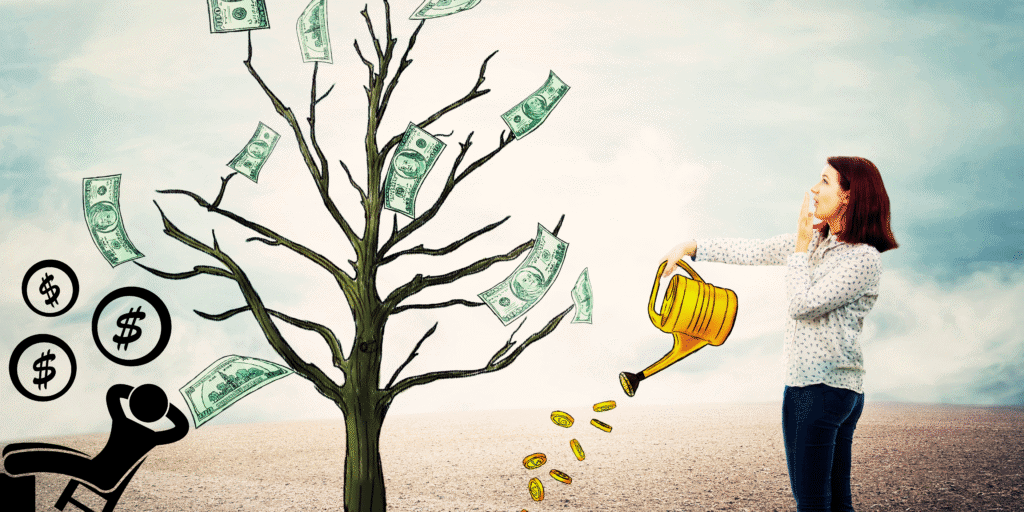
That’s why I believe now more than ever we need to think about passive income not as a flashy “get-rich-fast” fantasy, but as tiny lifelines. Even $20 or $50 a month extra isn’t nothing. Over time, it can build breathing room. It can turn “what-if” fear into “I’ve got a cushion” relief.
So if you’re tired, overwhelmed, or uncertain I see you. And I wrote this for you.
2. What “Passive Income” Even Means (In 2025) — Real Talk
When you read “passive income,” a lot of blogs make it sound like magic: “earn thousands while sleeping!” But that’s not what I mean by realistic passive income, especially for someone on a tight budget.
Here’s how I think about the terms, now:
- Active income = you swap time/effort for money (your job, a second hourly shift, babysitting, etc.).
- Semi-passive income = you invest effort once or a few times, then try to earn something over time (for example, creating a digital product, writing a short e-book, setting up a cashback habit, or renting something you own).
- Passive income (realistic, slow-build) = income streams that may start tiny, take little to no money to begin, and can gradually grow or at least stay steady without you pouring in excess time or stress.
Important note: “Passive” doesn’t mean “zero work forever.” It means manageable, flexible, low-stress. Especially for families with unpredictable schedules, kids, or other constraints.
For many low-income families, starting small is the only practical path maybe $20/month now. But over months and years, $20 → $50 → $150 → $300 can make a real difference.
3. Why It’s Particularly Tough for Low-Income Households — and Why Small Steps Matter
I get it. When money is already tight, when time is swallowed by work and responsibilities, when childcare and rent feel like anchors — the idea of “side income” can feel exhausting.
Here are the main obstacles:
- Time scarcity: After long shifts or multiple jobs, who has brain space for a side hustle?
- No cushion: No savings means no safety net to fall back on — which makes every risk feel heavier.
- Childcare & commitments: Maybe you can’t just “stay up late” or “work weekends” without huge cost or exhaustion.
- Burnout & mental load: When life already drains you, adding more work may feel impossible.
- Unpredictable income & shifts: Variable hours make it hard to plan extra work or commitments.
But here’s the philosophy I’ve come to and I want to pass it on to you: small efforts, compounded consistently, can build real stability. You don’t need to launch a business. You just need small, sustainable streams that won’t compete with your sanity.
4. 12 Realistic, Low-Cost (or No-Cost) Passive Income Ideas for 2025
Here are ideas that don’t require a big investment, a degree, or a risky commitment just a bit of time and persistence.
| # | Idea | What You Need | Realistic Potential (2025) | Good For / Start Small By… |
| 1 | Micro-digital products (printable templates, simple planners, budget sheets) | A phone/computer + free design tools (e.g. Canva) | $5–$100/month depending on volume | People good at organizing / creatives — create 1–2 templates this month and sell on Etsy / Gumroad |
| 2 | Cashback & rebate automation (shopping apps, grocery rebates) | Phone + grocery/receipts habit | $5–$25/month extra | Families who shop regularly — always scan receipts, enroll in apps |
| 3 | Rent out items you own (tools, baby gear, parking, storage) | Owned items, free listing on local rental apps | $10–$100/month depending on demand | People with spare stuff — list 1 item, validate demand before adding more |
| 4 | “Slow-build” content income (blog, niche social media, local community tips) | Phone or slow schedule + gradual posting | $0–$50/month at first; more over time if consistent | Parents or people with stories to share — 1 post/week, share carefully |
| 5 | AI-assisted micro-tasks → scalable freelance income (transcript editing, simple content creation) | Phone / laptop, basic skills | $50–$200/month extra over time | Shift workers with odd hours — 30 mins before bed, build profile slowly |
| 6 | Phone-based side income systems (cash-back cards, reward apps, survey-style apps, small gigs) | Phone + some spare time | $5–$20/month — small buffer | Those with unpredictable jobs — treat as extra “margin money,” not main income |
| 7 | Affiliate income from everyday life (recommend products/services you already use) | Honest reviews, social media / network | $10–$50/month (small friend-based income) | People comfortable recommending — start with small trusted circle |
| 8 | Print-on-demand with low-effort designs (t-shirts, mugs, simple slogans) | Phone/computer + free art tools | $0–$50/month initially | Creative folks — start with 1 design, minimal cost |
| 9 | Local service referral networks (babysitter referrals, house cleaning, rideshare referrals) | Talking to neighbors/friends + reliability | $20–$100/month | People with community ties, trust — post flyers, start small |
| 10 | Teaching small digital / life skills (basic phone apps, language tutoring, craft workshops) | Your knowledge + time | $25–$75/month depending on demand | People with skills others need — offer 1 hour/week online or in person |
| 11 | Sell gently used items online (clothes, baby gear, furniture) | Some time and photos | $5–$100/month depending on inventory | People replacing stuff anyway — list items over time |
| 12 | “Safety net interest” — use high-yield savings / money market accounts | An account + small deposit | 3–5% APY interest (better than 0.5%) Bankrate+2Investopedia+2 | Anyone with even $100 — move to HYSA rather than letting cash sit idle |
5. Why These Ideas Work in 2025 — and Why They’re More Than “Hustle Culture”
- High yields on savings make liquidity more valuable: High-yield savings accounts (HYSA) now pay up to ~5.00% APY a huge leap compared with rock-bottom rates of just a few years ago. Investopedia+1 That means even small balances earn noticeable interest, making savings part of your income strategy.
- Gig economy & multiple jobs are rising (not declining): In 2025, about 8.9 million Americans are working more than one job a record high. Forbes+1 It’s a sign that many households need more than one income stream but “side jobs” don’t have to drain your energy. The passive/semipassive ideas above give alternatives.
- You don’t need capital just consistency: Many of these ideas require no upfront money, just a little time or resourcefulness. That reduces the risk for low-income families.
6. Starter Paths: Choose What Fits Your Life Right Now
Here are gentle, realistic roadmaps depending on your starting point:
Path A: You Only Have 1 Hour a Day
- Use that hour to set up cashback/rebate apps make scanning receipts or checking offers a habit.
- Spend one night creating a micro-digital product (e.g. a budget tracker, a printable chore chart) — publish it on Etsy or Gumroad with $0 upfront cost.
- Automate savings: open a high-yield savings account (HYSA), transfer $10–$25 the same night. It grows slowly but adds up.
Path B: You Have $0 to Invest — Just Your Phone & Internet
- Start selling gently used items, or list a spare chair / baby item / tool on a local rental app.
- Try small phone-based income: cashback apps, reward apps, maybe micro-tasks that fit into shift work downtime.
- Once you earn even a little, start building your HYSA cushion.
Path C: You Have a Skill (Cooking, Tutoring, Crafts, Languages) — But Low Confidence
- Design a simple offer: 1-hour tutoring, basic craft kits, or digital planning templates.
- Use social media or local groups to share — real people appreciating small budgets often pay value, not perfection.
- Reinvest small earnings wisely: split half to savings, half to build the next offer.
7. Counter-Intuitive Truths What Most “Side Hustle” Guides Don’t Say
- Passive income doesn’t start passive: Most “passive” streams need effort at the start. The secret is small, sustainable effort that doesn’t drain you.
- Even $30/month changes more than your bank balance it changes your headspace: That extra margin can mean the difference between skipping the dentist or getting care, or handling a car repair without panic. It buys peace of mind.
- Low-income households usually need micro-income, not giant side gigs: The goal isn’t to replace your main job. It’s to build flexibility, resilience, breathing room.
- Automation is passive income for people without savings: Automatic transfers, auto-listing of items, scheduled digital product drops they reduce mental load while building income.
8. How Extra Income = Emotional & Psychological Relief
I’ve seen it myself: when you know there’s a little buffer — when rent is paid and there’s $50 extra — you breathe easier. You don’t cringe when the light bill comes. You don’t feel the same weight when the kids get sick or the car needs a fix.
That isn’t small. That’s freedom. Not the flashy kind — but real, everyday dignity. You tell yourself: “I’m not scrambling this time.” That breathing room brings clarity, less panic, more strength.
Even modest passive income helps:
- It reduces financial anxiety — you stop living paycheck to paycheck by a thread.
- It gives you choices — skip a shift, say no to toxic work, or invest in something better.
- It builds confidence — you start seeing yourself as someone who doesn’t just survive, but plans and protects.
9. How to Start Today: Your Simple Checklist
Here’s a practical “first day / first week” plan:
- Take stock: write down monthly essentials, and estimate how much a tiny extra $50–$100 would help.
- Open a high-yield savings or money-market account (with no or low minimums).
- Install one cashback / rebate / savings app — commit to scanning receipts or checking it once per shopping trip.
- List one item you don’t need — baby gear, tools, clothes — on a resale or rental platform.
- Pick one small digital product or skill you can offer — even a simple printable planner or tutoring one hour a week.
- Set a schedule — block 30 minutes twice per week to work on your side idea, but treat it like self-care, not a burden.
- Track progress — start a free spreadsheet (or notebook), write income streams and small wins (even $5 counts).
What to avoid:
- Don’t chase “get-rich-fast” schemes.
- Don’t overwork yourself — burn-out defeats the purpose.
- Don’t spend your first earnings impulsively — treat them as your “margin.”
10. Final Thoughts: This Isn’t About Wealth — It’s About Stability, Dignity, and Hope
I won’t promise you’ll get rich. But I will promise you this: if you start small, treat yourself with patience, and choose ideas that honor your time and energy you can build a cushion. Something that turns “What if…” into “I can handle it.”
For low-income families juggling too much, that cushion isn’t optional. It’s essential.
If you begin today with a small app, a borrowed laptop, or a sold chair you’re already walking toward a future where you’re less reactive and more in control.
Bonus “Starter Worksheet”: How to Launch Your First $25–$100 Passive Income This Month
| Step | Action |
| 1 | List one small asset or item to sell/rent. |
| 2 | Pick one side income idea (cashback app, digital product, micro service). |
| 3 | Open high-yield savings or money-market account. |
| 4 | Schedule 2 × 30-minute “side income work” sessions this week. |
| 5 | At month’s end: total extra income earned, deposit into HYSA, note emotional/financial difference. |
Say to yourself: This is not hustle. This is protection. This is care.
You don’t need a big budget or a fancy degree. You just need hope, consistency, and a little faith that things can and will get better — one small income stream at a time.