Let’s be honest: $10 doesn’t feel like much anymore
It’s a latte and a croissant at your favorite café. It’s that DoorDash delivery fee you sigh about but pay anyway. It’s one of those random Amazon “add to cart” moments that you forget about the next day.
We’ve all been there. And because $10 feels small, it slips through our fingers without much thought. But here’s the wild part: that same $10, if treated differently, can quietly build you a six-figure future.
Not overnight. Not with some sketchy get-rich scheme. Just with the power of small, steady habits that stack up over time.
Today, I want to show you how turning a daily $10 into an intentional habit can grow into $100,000—and why it matters more than you think. Think of this less like a lecture and more like a money pep talk from a friend who’s rooting for you.
The Hidden Emotional Side of $10 Habits

The thing about money is that it has nothing to do with math. It’s about how you feel.
This makes you think, the moment you redirect that daily $10, you’re not just padding your bank account—you’re building self-trust. You’re proving to yourself: “I can set a goal and follow through.”
That confidence spills into other parts of your life. Suddenly you feel lighter when bills show up, calmer when your car makes a weird noise, and more optimistic when you think about your future.
at the end of the day, It’s not really about the money it’s about the peace of mind. And peace of mind is priceless.
How to Trick Your Brain Into Saving Without Feeling It
So, in theory is easy to say „just start saving”, but the reality begs a different scenario for all of us. Now, what if I tell you that there’s some really great ideas that won’t make savings like “losing out.” Here are some brain hacks to flip the script.
- Rename your account. Don’t call it “Savings.” Call it “Freedom Fund” or “Travel 2028.” Suddenly, you’re not losing $10—you’re buying freedom.
- Hide your balance. Some apps let you blur your savings total until you hit milestones. It’s like a surprise gift to your future self.
- Use defaults. Set up auto-savings the same day your paycheck hits. Your brain never sees that money, so it never mourns it.
- Gamify it. Challenge yourself to beat last week’s $10 by $1 or $2. Micro-competition keeps it fun.
The trick isn’t willpower it’s wiring your brain so saving feels natural.
So, why $10 Is the Sweet Spot?
I bet that your first thought from the moment you saw that titleof this post was why not $1? why not $100? The short answer is that $10 is in that perfect zone:
- It feels small enough that you can find it almost anywhere in your budget.
- It’s big enough that, over time, it makes a real difference.
- It’s flexible—you can save it, invest it, earn it, or redirect it.
Think about it: $10 is less than most fast-food meals. But $10/day adds up to $300/month. And when invested, that $300 becomes six figures over time.
Please, don’t consider like you are depriving yourself, it’s about realizing how powerful your smallest choices really are.
The Psychology of Small Money Habits
Money habits work the same way as health habits.
- One salad won’t change your life, but eating one every day will.
- Skipping the gym once doesn’t matter, but skipping it for a year does.
- Spending $10 today doesn’t sink you, but spending it every day for years does.
Psychologists call this the compound effect of habits. Your brain underestimates how tiny actions add up because we’re wired for instant gratification.
That’s why $10 is sneaky powerful: it’s small enough to slip under your radar, but big enough to rewrite your financial story if you repeat it daily.
The Math: From Pocket Change to $100K
Let’s stop for a second and crunch some real numbers.
- $10/day = $300/month = $3,600/year.
- In 10 years, that’s $36,000 saved (before interest).
- Invested at a 7% annual return: about $52,000.
- In 15 years: nearly $93,000.
- In 20 years: around $150,000.
That’s why this works. It’s not that you save $100K—it’s that you let compound growth do the heavy lifting. As Albert Einstein said: „Compound interest is the eighth wonder of the world. He who understands it, earns it… he who doesn’t… pays it.”
Imagine your future self at age 40, 50, or 60 saying: “Thank you for those tiny $10 decisions. Because of them, I have options, freedom, and less stress.”
How to Build Savings Fast With $10 a Day
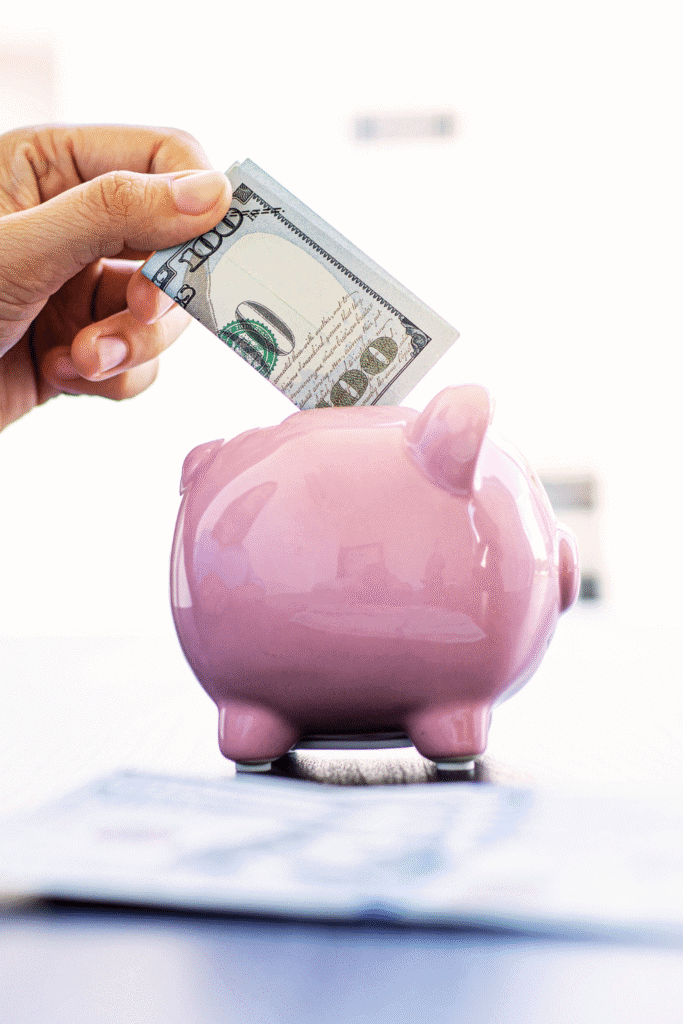
Ok, enough already with theory, here’s where we get practical. You don’t need to overhaul your life. You just need to redirect small money leaks.
Lifestyle Swaps That Don’t Feel Like Sacrifice
- Coffee shop → home barista: Buy a $30 frother, learn one YouTube recipe, and suddenly your $5 latte is 75 cents.
- Delivery fees → walk pick-up: If you grab takeout yourself twice a week, you save $20. That’s your $10/day right there.
- Streaming overload → pick your favorite: Most of us pay for 4+ services. Cancel two, save $20/month.
- Impulse Amazon buys → 24-hour rule: Put items in your cart, wait 24 hours. Most vanish from your “must-have” list.
From Zero to $10 a Day: How to Start if You’re Broke
Now, I know the reality because I experience it myself: not everyone has $10 lying around, some not even $1. And that’s okay because you can create it.
- Sell unused stuff. Clothes, books, old electronics—$50 here and there can fund your habit for weeks.
- Use cashback apps. Rakuten, Ibotta, Honey. Every little rebate gets funneled into your fund.
- Mini side hustles. One $30 gig on TaskRabbit can cover three days of savings.
- Audit bills. Call your phone company, your insurance, your internet. Often you can shave $10–20 off without changing a thing.
If $10 feels impossible, start with $1/day. Build the habit first. Once it’s automatic, you’ll find ways to grow it.
Micro-Hustles That Create $10/Day (and How to Actually Make Them Work)

Sometimes, cutting expenses wel,l it isin’t cut it. That’s when creating a small income stream—just $10 a day—can change the game. But here’s the key: it’s not about hoping it works—you need a plan, tools, and a little strategy.
1. Pet Sitting / Dog Walking
Pet sitting isn’t just cute; it’s surprisingly lucrative. Apps like Rover and Wag! make it easy to connect with clients, but there are ways to maximize your earnings:
- Profile matters. Upload clear photos, list your experience, and include local references. Clients pick people they trust, not just anyone.
- Set a fair starting rate. Even $15–20 per walk or visit can cover multiple days of your $10 habit.
- Schedule efficiently. Cluster walks in the same neighborhood to save time and gas.
- Offer extras. Sending updates or photos during walks can justify a slightly higher rate and build repeat clients.
- Local networks. Don’t rely only on apps—post in neighborhood groups or on Nextdoor. Sometimes local gigs pay more and don’t take fees from the app.
Insider tip: Weekends are prime time. If you can handle short morning walks on Saturday and Sunday, you can earn $40+ without disrupting your weekday schedule.
2. Online Surveys & Microtasks
It’s tempting to dismiss surveys as “low pay,” but consistency and strategy make them viable for small daily goals:
- Best platforms: Swagbucks, InboxDollars, Survey Junkie, or Amazon Mechanical Turk. Pick 1–2 platforms and stick with them rather than hopping around.
- Timing strategy: Answer surveys during downtime—like your commute (if you’re not driving), lunch breaks, or waiting for appointments.
- Avoid scams: Never pay to join, and watch for surveys that promise hundreds of dollars in minutes. Stick with reputable apps.
- Maximize cashback: Some survey apps have bonus programs—stacking these can bump your $5–10/day goal up to $15–20 on a good day.
Pro tip: Track which surveys pay the most per minute. Some surveys take 30 minutes for $3; others take 5 minutes for $1. Prioritize the higher pay-per-minute options.
3. Freelance Gigs
If you have a skill—writing, graphic design, social media, tutoring—you can make $10/day in minutes:
- Platforms to start: Fiverr, Upwork, or Etsy (for digital downloads). Start small—offer “micro gigs” under $10–20.
- Niche matters: Pick a very specific service (e.g., Instagram template design, resume tweaks, short math tutoring). Niches reduce competition.
- Portfolio first: Even one sample can make clients trust you. You can create free examples if you don’t have paid experience.
- Repeat clients: Offer discounts for repeat work—your $10/day habit becomes recurring income rather than one-off.
Insider tip: Many people think freelance success takes months, but micro-tasks like proofreading, short designs, or one-page consulting can net $10–15 in under an hour—perfect for small daily savings.
4. Reselling
Flipping items isn’t just selling junk—it’s strategic income. You can cover your $10/day habit with just a few well-chosen items:
- Where to sell: Facebook Marketplace, Poshmark, eBay, Mercari, OfferUp. Local sales often avoid shipping hassles.
- Start with what you have: Old clothes, books, electronics, or even collectibles. People pay for convenience and access.
- Price smart: Check what similar items sell for. Price slightly below the average for a fast sale, or list higher if you can wait.
- Bundle for faster turnover: Selling 3–5 small items together can hit your $10 target in one transaction.
- Photos & descriptions: Clear pictures + honest descriptions = faster sales and repeat buyers.
Pro tip: Seasonal items sell better at certain times. Winter coats in fall, school supplies in late summer. Timing your listings can make reaching $10/day much easier.
Extra Tips to Make All Micro-Hustles Work
- Stack income sources. One day you might do a dog walk, a survey, and resell an item. Combined, it’s way more than $10/day.
- Set daily mini-goals. Treat it like a habit, not a bonus. For example: “Earn $10 today for my future self.”
- Automate where possible. Use calendar reminders for walking dogs, notifications for survey openings, and auto-posting for resale listings.
- Track earnings. Even small wins feel bigger when logged. It’s motivating and helps you see progress.
- Time-block micro-hustles. 15–30 minutes/day consistently often beats random, scattered attempts.
Bottom line: $10/day doesn’t require a major career shift. It can come from small, achievable gigs that anyone can start today. The real power comes from consistency, tracking, and using the tricks that most people ignore.
Set It and Forget It: Automation Tricks That Do the Work for You
Here’s the truth that applies daily, even for you: most of us are not going to manually move $10 every single day. Life’s busy. You’ll forget. Or you’ll “mean to do it later” and never get around to it. That’s why automation is your best friend. Once you set it up, the money moves without you even noticing—and that’s the magic.
Let’s break it down, step by step, so you can pick what works for you:
1. Bank Auto-Transfer (the “pretend rent” method)
Almost every bank lets you set up automatic transfers. Here’s how to do it in plain English:
- Log into your banking app.
- Find the “Transfers” or “Move Money” section.
- Pick the amount (say $70 per week, which equals about $10/day).
- Choose a separate savings account as the destination.
- Pick the day (for example, every Friday after payday).
That’s it! The money slides out before you can spend it. Treat it like rent or your phone bill—you don’t argue with those, right? Same mindset here.
Pro tip: If you don’t already have a separate savings account, open one at an online bank like Ally, Capital One 360, or Marcus by Goldman Sachs. They’re free, easy to use, and usually give you a better interest rate than your regular checking.
2. Round-Up Apps (spare change magic)
Ever bought something for $4.25 and thought, “If this were cash, I’d toss the 75¢ into a jar”? That’s exactly what round-up apps do, but digitally.
- Acorns: Connect your debit or credit card, and it automatically rounds each purchase to the nearest dollar. So that $4.25 coffee gets rounded to $5, and the extra 75¢ gets invested for you.
- Chime: Works the same way, but instead of investing, it saves the change into a Chime savings account.
Pro tip: Don’t underestimate this! Most people save $20–50/month without even noticing. That’s half your $10/day goal—completely painless.
3. Employer Direct Deposit (the sneaky saver)
This is one of my favorite hacks because you literally never see the money—it skips your checking account altogether.
- Ask HR (or check your payroll portal) if you can split your paycheck into more than one account.
- Set up a second account (could be at a different bank so you’re not tempted to touch it).
- Tell payroll: “Send $300/month” (or $70/week) straight into this “future fund.”
You’ll never even feel it leave because it never touches your spending account in the first place. Out of sight, out of mind.
4. High-Yield Savings “Vaults” (bucket system)
A lot of modern banks now let you create “vaults” or “buckets” inside one savings account. Think of them like little jars with labels.
- Ally Bank calls them “Buckets.”
- Capital One 360 calls them “Performance Savings goals.”
- SoFi and Monzo let you name your “vaults.”
So instead of one lump savings balance, you can split your money into different goals: “Emergency Fund,” “Vacation,” “Future $100K.” Seeing the label makes it real, and keeping it separate keeps you from “accidentally” dipping into it.
Pro tip: Hide the account from your main dashboard if your bank allows it. Less temptation, more growth.
Bottom line: The trick isn’t more willpower—it’s smarter systems. Set it up once, let the apps and banks do their thing, and then just… forget about it. Your $10-a-day habit will keep humming in the background while you go on living your life.
The Daily Savings Challenge (That Actually Works)
Want to gamify it? Try this:
- Week 1: Save $1/day.
- Week 2: Save $2/day.
- Keep going until you hit $10/day.
By easing into it, you train your brain (and budget) without shock. Bonus: you’ll have saved $385 in just 10 weeks.
Overlooked Tricks Most People Don’t Use To Save Money

Here are some strategies you might not have heard of:
1. Credit Card Rewards → Savings Transfer
What you wrote is smart, but let’s make it practical.
- Most banks (Chase, Citi, Amex) let you choose how you redeem points: statement credit, gift cards, or direct deposit. Pick direct deposit to your savings account.
- If your bank doesn’t auto-deposit, here’s a hack: set a calendar reminder to transfer cashback monthly into your “$10-a-day” fund.
- Pro move: Use a cashback portal like Rakuten or TopCashback alongside your card. That way, one purchase earns double cashback—your card’s rewards + the portal’s bonus. Redirect both into savings.
Upgrade: Treat rewards like “found money.” If you earn $25 in a month, add an extra $25 from your checking. Boom—$50 saved without touching your lifestyle.
2. Bill Negotiation Services
Trim and Truebill (now Rocket Money) are great, but here’s the catch: they usually take a cut of the savings.
- If you want to DIY: call your internet, phone, or insurance provider once a year and say, “I’ve seen competitors offering a better rate—what can you do for me?” Often they’ll knock off $10–20/month just to keep you.
- Hidden gems:
- Billshark and BillCutterz also negotiate bills.
- Some credit unions or banks (like USAA) have their own bill-lowering services.
- Stack this with energy-saving apps like OhmConnect (where available)—they pay you to use less electricity at peak times. That’s another $5–20 you can redirect.
Upgrade: Take half your “bill savings” and stash it immediately so it doesn’t disappear into lifestyle creep.
3. Library Apps (Libby, Hoopla)
Love this one. But let’s make it richer.
- Libby & Hoopla = free audiobooks, ebooks, comics, and even streaming movies if your library participates.
- Kanopy: Another free app many people miss. Tons of indie films, documentaries, even Great Courses.
- Don’t forget your physical library. Many lend out board games, tools, museum passes, and even Wi-Fi hotspots. That’s real-world savings people never think about.
Upgrade: Cancel one paid subscription at a time (Spotify, Kindle Unlimited, Audible) and replace it with library resources. Each cut frees up $10–15/month for your fund.
4. Employer Stock Purchase Plans (ESPPs)
This one’s golden but under-explained. Let’s spell it out:
- Some companies let you buy stock at a discount (5–15%) through payroll. For example, you can buy $100 worth of stock for $85.
- That means you instantly gain $15 in value—the fastest return on investment you’ll ever see.
- Even if you sell immediately, that built-in discount becomes “free money” you can reroute into your $10-a-day savings.
Upgrade: If your company also offers a 401(k) match, that’s another hack—your contributions are essentially doubled. Don’t leave that free money on the table.
5. “No Spend” Days
A classic trick, but here’s how to make it actually work (instead of feeling like punishment):
- Start small: one “no spend” day per week. Essentials only (groceries, gas, rent are fine). Everything else waits.
- Make it fun: pair it with a cozy ritual—homemade coffee, free library movies, or a long walk. It feels intentional, not restrictive.
- Track it: If you normally spend $15 on random stuff on Tuesdays, transfer that $15 into your “future fund” instead.
Upgrade: Gamify it. See how many no-spend days you can string together in a row. Or challenge a friend and make it competitive.
Bonus Hacks Most People Don’t Know
- Hidden bank “round-ups”: Banks like Bank of America (Keep the Change), Qapital, or Chime auto-round purchases and stash the difference. Set it once, forget it.
- Cashback stacking: Use a cashback site (Rakuten), a cashback credit card, and a cashback app (Ibotta or Dosh) on the same purchase. Triple dip!
- Hidden savings accounts: Some banks let you open “sub-accounts” with no visible balance on your main dashboard. Ask your bank if they can hide it from online view. Out of sight, out of mind.
- Pay-yourself-first refunds: Every time you get a refund (Amazon return, insurance rebate, tax return), pretend it never existed. Transfer 100% to savings.
A Step-by-Step Plan for Beginners
- Track leaks for 7 days. Write down every under-$10 spend.
- Pick one swap. Coffee, delivery, apps—choose the easiest first.
- Automate $10/day. Transfer $70/week into a hidden savings or investment account.
- Stack hacks. Add round-ups, cashback, and side hustle trickles.
- Review quarterly. Celebrate milestones ($1K, $5K, $10K). Motivation is fuel.
The Empowering Truth
Here’s the real takeaway and a lesson I personally learned:
$10 isn’t just $10. It’s a seed. Every day you plant it, you grow something that your future self will thank you for.
It’s not about deprivation—it’s about direction. Every small choice you make is a vote for the kind of life you want down the road: more freedom, less stress, and the peace of knowing you’ve got a cushion.
So the next time you’re about to spend $10 without thinking, pause. Ask:
“Do I want this now… or do I want $100,000 later?”
And sometimes, sure, the answer will be “yes, I want the coffee.” But if you say “future me” more often than not, you’ll build something life-changing.
Quick Disclaimer
This is not professional financial advice. Just personal strategies and stories to inspire you. Everyone’s situation is unique—so before making major money moves, consider talking to a licensed financial advisor.
Final Thought:
Small money habits aren’t small at all. They’re the building blocks of long-term wealth, freedom, and opportunity. And it all starts with one simple habit: $10 a day.